For many business owners, the allure of a “bargain” website is hard to resist. When you’re just starting out or working with a tight budget, a low-cost, quick-turnaround website seems like the ultimate win. It gets you online, it looks “good enough,” and it saves you money upfront.
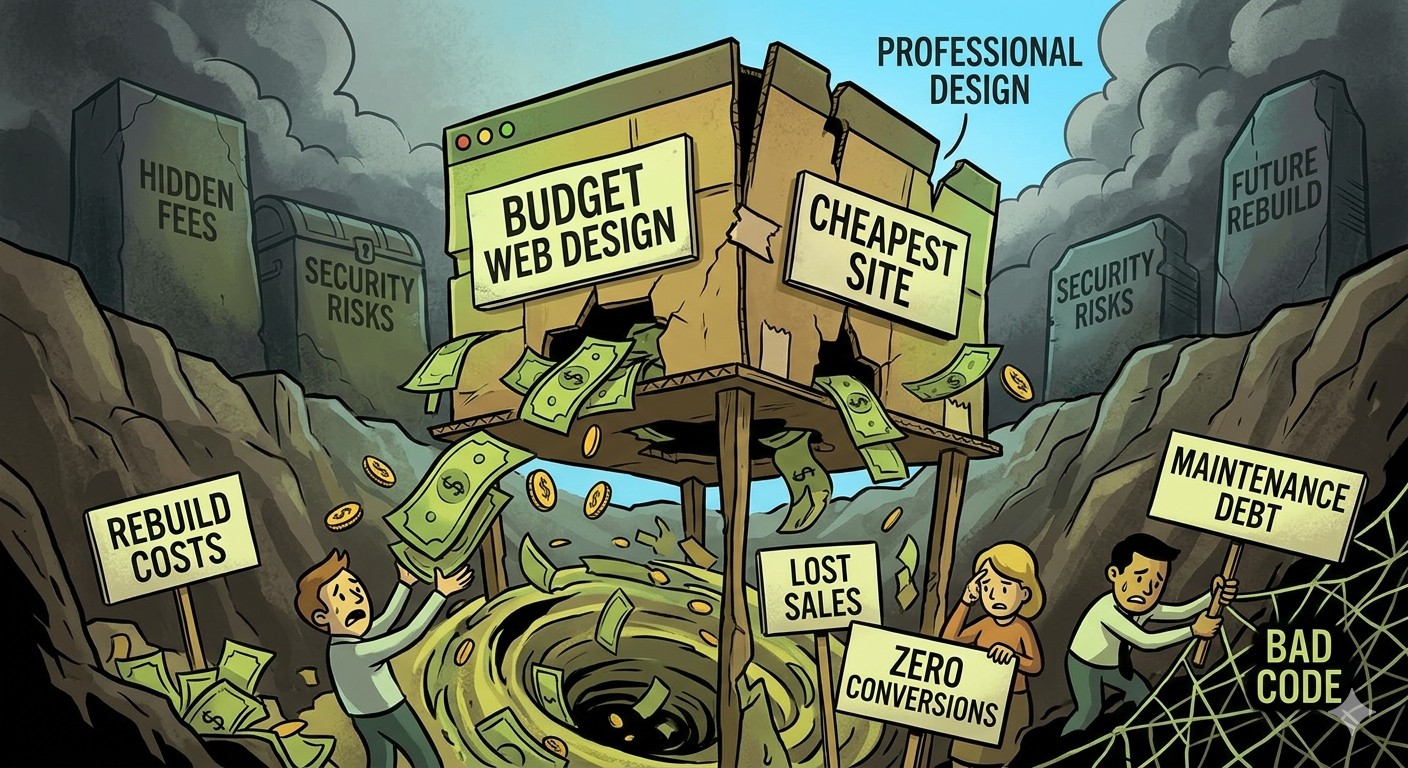
But here is the hard truth that many business owners learn the expensive way: Cheap website design is rarely actually cheap. Instead, it is a “false economy” that delays, multiplies, and hides costs until they eventually manifest as lost sales, technical headaches, and the inevitable price of a complete, ground-up rebuild.
If you’re considering cutting corners on your digital presence, here is what you need to know about the hidden costs beneath that low price tag.
1. The “Rebuild” Penalty
The most common outcome of a bargain-basement website is that it eventually hits a wall. Whether it’s an inability to scale as your business grows, clunky code that prevents updates, or a design that simply can’t handle modern traffic, you will eventually reach a point where the site can no longer serve your needs.
When that happens, you don’t just “fix” the site you have to rebuild it. This means you end up paying for the same asset twice, effectively doubling your investment and wasting the time you spent maintaining the original “cheap” version.
2. Lost Revenue: The Silent Drain
A professional website is a sales machine; a cheap website is often a digital roadblock. The true cost of a bad site isn’t just what you spent on the developer it’s the opportunity cost.
- Poor Conversion Rates: Cheap sites are rarely built with user psychology or conversion paths in mind. If your contact forms are buried or your calls to action (CTAs) are unclear, visitors will bounce.
- SEO Failures: Budget builders often ignore the foundational SEO (Search Engine Optimization) required to rank on Google. If your site isn’t discoverable, your marketing budget is essentially being thrown into a black hole.
- High Bounce Rates: In the era of mobile-first browsing, a site that loads slowly or breaks on a smartphone is a death sentence. Research consistently shows that users judge credibility within seconds; if your site feels “cheap,” they assume your business is, too.
3. The “Maintenance Nightmare” Tax
Ever tried to change a price or update your business hours, only to find the back-end is a labyrinthine mess? Many low-cost websites are built on rigid, proprietary frameworks or bloated templates that make even minor updates impossible without hiring a developer.
Suddenly, you’re paying a freelancer $50–$100 just to swap out an image or update a line of text. Over time, these “maintenance taxes” add up to significantly more than the cost of a professional, user-friendly platform that would have empowered your team to make those changes themselves.
4. Vendor Lock-In and Ownership Issues
One of the most dangerous hidden costs is the loss of control. Some agencies build sites on their own proprietary systems, effectively “leasing” your website to you. If you ever want to leave, you can’t simply export your files; you are locked into their ecosystem. You’re left with two painful choices: keep paying their fees forever, or abandon your site and start over from scratch elsewhere.
5. Security and Compliance Risks
“Cheap” often means “no budget for security.” Professional design includes essential safety measures like SSL certificates, regular plugin updates, and secure hosting environments. A budget site is often an easy target for hackers. A single security breach can lead to:
- Data loss or theft of customer information.
- Blacklisting by search engines.
- Significant downtime that drives customers to your competitors.
How to Protect Your Investment
You don’t need to spend six figures to have a great website, but you should treat your site as an asset, not an expense. Before you hire someone, look for these signs of true value:
- Strategic Focus: Do they ask about your business goals, target audience, and conversion strategy? Or are they just talking about templates and speed?
- Ownership and Portability: Ensure you will own your site and its content, and that it’s built on a standard, portable platform (like WordPress, Webflow, or Shopify).
- Scalability: Ask them how the site will handle growth. A good designer builds for where you want to be in two years, not just where you are today.
- Transparency: A professional will be honest about what your budget can achieve. If a quote seems too good to be true, it’s because they’re planning to cut the corners listed above.
The Bottom Line
Your website is often the first interaction a potential customer has with your brand. It’s the digital face of your company, operating 24/7. When you prioritize price over performance, you aren’t saving money you’re borrowing it from your future revenue. Invest in quality the first time, and you’ll find that a well-built website doesn’t cost your business; it pays for itself.
Are you currently weighing your options for a new website build? Let’s discuss what a sustainable, growth-oriented investment looks like for your specific business goals.