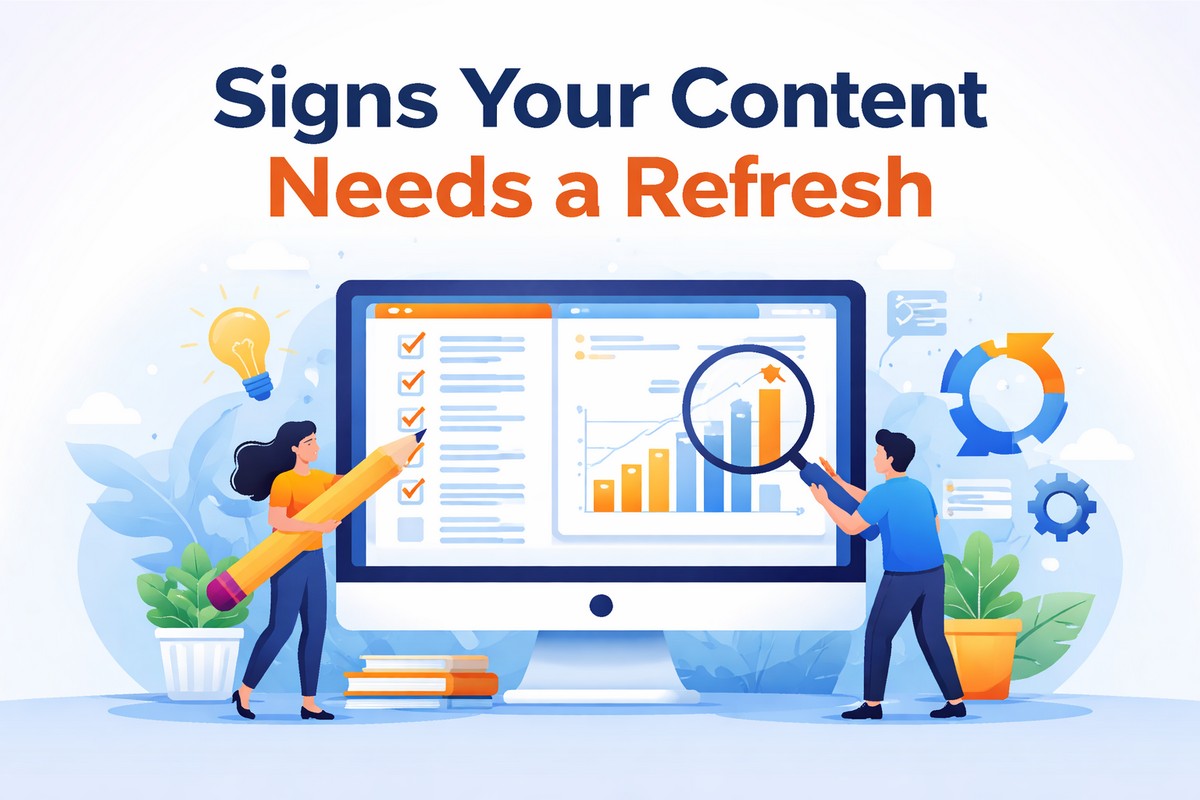
Your website content plays a major role in how customers perceive your brand, how search engines rank your pages, and how well your marketing converts. But content doesn’t last forever.
Even high-performing pages can slowly lose relevance as trends change, algorithms evolve, and customer expectations grow. If your content hasn’t been reviewed in a while, it may be quietly hurting your visibility and credibility.
Here are the key signs your content is outdated — and when it’s time to refresh it.
1. Your Traffic Has Declined Over Time
One of the clearest indicators of outdated content is a steady drop in organic traffic. If a page used to perform well but no longer brings in visitors, it may be losing relevance in search results.
Search engines favor content that is current, accurate, and useful. When competitors publish updated resources, your older pages can slowly slip down the rankings.
When to refresh:
If traffic has declined for 3–6 months with no technical issues present, it’s time to update the content.
2. Information Is No Longer Accurate
Outdated statistics, old pricing, discontinued services, or references to past trends instantly reduce trust. Visitors expect information to be current — especially when making purchasing decisions.
Even a single outdated fact can cause users to question your credibility.
When to refresh:
Immediately. Accuracy is non-negotiable for brand trust.
3. Your Content Doesn’t Match Your Current Brand
As your business grows, your messaging evolves. If your content still reflects an older version of your brand — outdated tone, visuals, or value propositions — it creates inconsistency.
Your website should represent who you are today, not who you were years ago.
When to refresh:
When branding, services, or target audiences change.
4. Engagement Is Low
High bounce rates, low time on page, or minimal conversions often point to content that no longer connects with users.
Today’s visitors expect:
- Clear structure
- Scannable headings
- Visual elements
- Strong calls to action
If your content feels dense or dated, users will leave quickly.
When to refresh:
When engagement metrics drop or conversions stall.
5. Your Content Isn’t Optimized for Modern SEO
SEO standards change constantly. Content written years ago may lack:
- Proper keyword targeting
- Internal links
- Optimized headings
- Meta descriptions
- Search intent alignment
Modern SEO is about usefulness, clarity, and user experience — not just keywords.
When to refresh:
If your content predates major SEO updates or wasn’t written with search intent in mind.
6. Competitors Are Outranking You
If newer competitor content is outranking yours, it’s a strong signal that your page needs updating. Search engines often prioritize freshness when multiple pages target similar topics.
Refreshing content can often outperform writing brand-new pages.
When to refresh:
When competitors publish more complete, updated, or visually engaging content.
7. Your Content Doesn’t Answer Current Customer Questions
Customer behavior changes over time. New objections, new tools, and new expectations emerge.
If your content no longer addresses what customers are asking right now, it loses effectiveness.
When to refresh:
When FAQs, sales conversations, or search queries shift.
How Often Should You Refresh Content?
A good rule of thumb:
- Blog posts: Review every 6–12 months
- Service pages: Review every 3–6 months
- High-traffic pages: Monitor quarterly
Refreshing content doesn’t always mean rewriting everything. Small updates can make a big difference.
What to Update When Refreshing Content
When updating older content, consider:
- Adding new statistics or insights
- Improving headlines and subheadings
- Updating internal links
- Enhancing visuals
- Strengthening calls to action
- Optimizing for current keywords
These improvements signal freshness to both users and search engines.
Final Thoughts
Outdated content doesn’t just affect rankings — it affects trust, conversions, and brand perception.
Regular content refreshes help:
- Improve SEO performance
- Increase engagement
- Strengthen credibility
- Keep your website competitive
If your content hasn’t been reviewed recently, now is the perfect time to start.